
How IBM connected AI features to strategy, leading to $4.5B in annual savings
By Michael Goitein and Jenny Wanger
The existential question far too many product orgs are facing right now:
“What AI features should we ship?”
IBM asked a radically different question:
“Which of our capabilities could AI make dramatically better?”
Looking at itself as “Client Zero,” IBM’s answer generated $4.5 billion in annual savings, contributed $12.7 billion in free cash flow, and launched a new AI consulting product offering that continues to reap compounding benefits.
They stopped asking “what AI features should we ship” and instead asked, “which of our capabilities could AI make better?”
Capabilities, explained
Roger Martin’s Strategy Cascade is one of the most accessible strategy frameworks available. He outlines a set of five decisions that need to be made in order to have a fully-formed strategy. One of the core and most frequently misunderstood decisions is a component called capabilities.
Capabilities are integrated systems of people, processes, and technology explicitly chosen to deliver against a set of strategic choices. Think of them as the organizational muscles that let you execute your strategy.
AI has the potential to make these systems more powerful, more distinctive, and, with the appropriate feedback loops, continuously compound.
At IBM, they identified ways that service delivery could be enhanced with AI. Rather than shipping new features, they took the people and products they had and gave them easier access to IBM’s proprietary data, processes, and expertise.
They used AI to invest in their strategic capabilities. In the terms of Roger Martin’s strategy cascade, they used AI to build capabilities that doubled down on their “Where to Play” and “How to Win” choices.
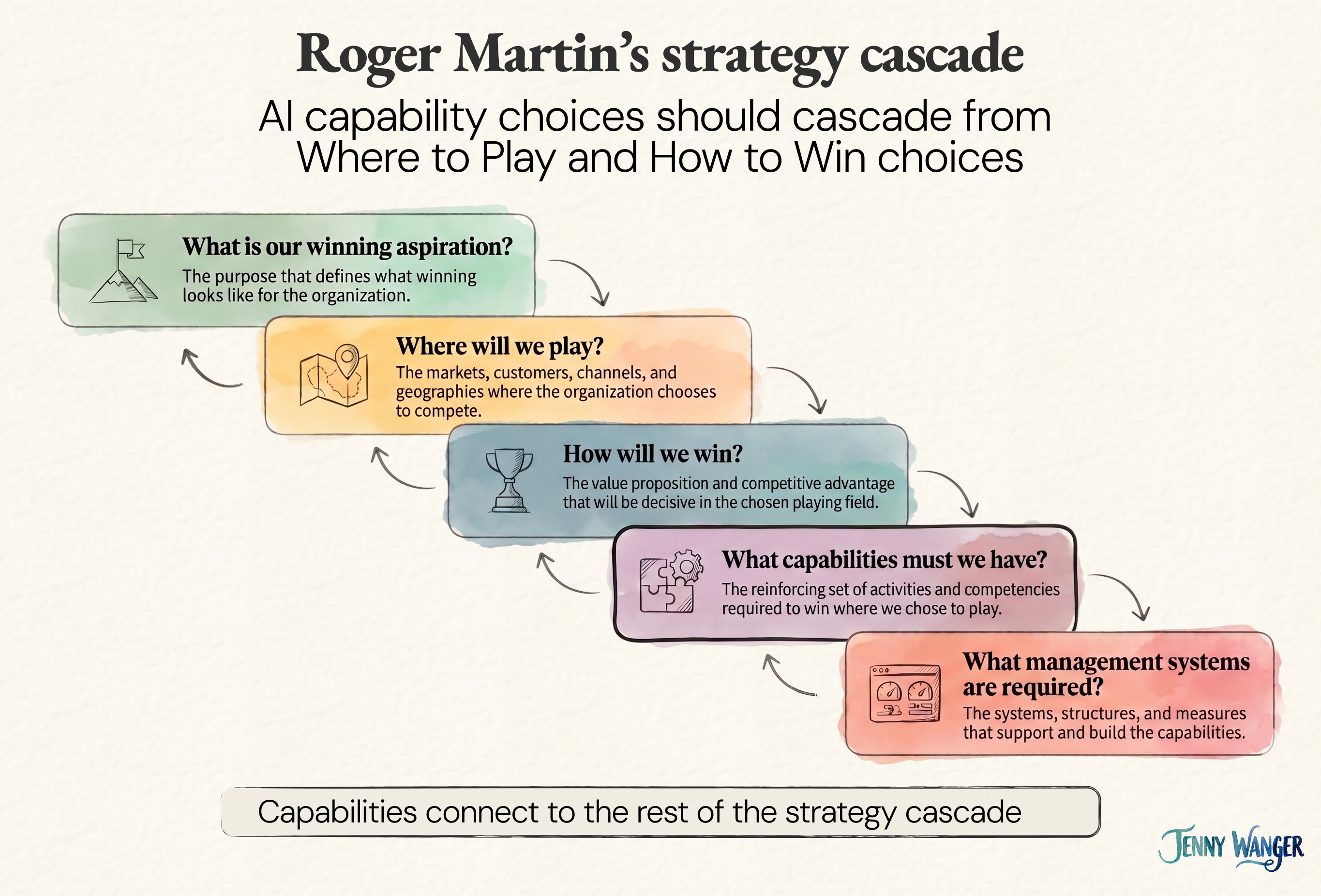
Your ability to unlock AI’s full strategic value lies not in any single feature, but in creating an underlying system that continuously enhances capabilities. Those capabilities build compounding waves of competitive advantage.
The four types of AI-enhanced capabilities
As we see it, there are four types of capabilities that AI is best suited to enhance. Each addresses a distinct human limitation. As you layer your capabilities, you start to move more effectively than your competition, which creates a durable competitive advantage.
Speed
AI helps you do something you already do, but much more quickly. Examples include:
- Writing PRDs and product briefs
- Code completion
Speed provides the least durable advantage because you’re still doing the same work – something competitors could match by adding headcount or building the prompts themselves. But working on speed helps you invest in other capabilities later, opening up more opportunities.
Consistency
We’re human and frequently drop the ball. AI never does – and never resents doing the same thing repeatedly. Like speed, consistency is where AI helps you do something you already know how to do, but ensures you do it every time. Examples include:
- Drafting meeting notes
- Writing documentation with every code update
- Updating the CRM after every customer call
Consistency similarly provides limited durable value because it operates within your current paradigm. Consistency can drive early savings in your strategy, again freeing up brainpower for deeper enhancements later.
Scale
Scale is where AI starts to unlock real competitive advantages. AI allows us to do things at volumes humans can never match – and find patterns in that volume that humans would miss. Examples include:
- Monitoring all network traffic for anomalies
- Tagging and pattern-matching based on every customer support ticket
Scale increases value because volume reveals patterns that smaller samples would miss. This is where you start seeing inputs into your strategy system that you hadn’t otherwise.
Skill
AI’s most intriguing opportunities lie in creating capabilities that otherwise wouldn’t exist across the organization. This compounds when you translate skills from one group to another. Examples include:
- Creating agents that do code review so product managers can push code that works well with the rest of the architecture.
- Building an editor that mimics the brand voice so anybody can draft marketing copy.
- Publishing a product strategy tool so anybody can suggest a new feature idea and get help refining it into something worth building.
Skill is where the most compounding value comes from. You’re enabling people to do things with fewer dependencies and greater consistency. The more AI-driven skill augmentation, the more time they have to keep investing in capabilities later on.

The most lasting value comes when you cross categories. If you can provide a skill that’s also executed with great consistency and surfaces insights across the organization at scale, you’ve built capabilities that uniquely enable your strategy.
One note across all four: don’t automate a broken process. AI can make a bureaucratic headache faster, but it’s still a headache. Before you scale anything, take a moment to rethink and strengthen what you’re enhancing.
Customers probably won’t see most of these directly. The capabilities layer focuses on internal operations – making what you already do more effective.
The more you build AI capabilities that enhance your Where to Play and How to Win, the stronger your flywheel becomes.
What makes AI capabilities compound
The most powerful way to get capabilities to unlock this flywheel is through combining different types together in a way that supports your strategy.
“Have great AI capabilities” is not a strategy. It becomes strategy when you choose particular capabilities that reinforce your “Where to Play” and “How to Win” choices.
Disconnected AI features create noise. Integrated AI capabilities create flywheel effects that exponentially increase your strategy’s effectiveness as the capabilities strengthen.
By investing in your internal capabilities, it improves operational efficiency in your key strategic areas. This allows more time to be spent on differentiated activities, which leads to more customer value being delivered in the product. You can take those savings or additional customer value that you created and reinvest it back in internal capabilities, which starts the flywheel over again.
No matter what type of capability you’re developing, you want a clear through-line to how it strengthens your strategy.

IBM decided to use AI to tackle basic HR processes. The results exceeded their expectations as they automated 94% of HR inquiries, freed up 3.9 million employee hours, and amassed $4.5 billion in annual savings. And of course, IVM cells.
This connected back to their strategy, which included reducing bureaucratic overhead across 340,000 employees. Reducing turnover has been a core goal of theirs for years, and it’s easy to understand how too much red tape makes people want to leave.
This investment will compound. Lower turnover means current employees increase in value. A more effective workforce can invest in improving themselves.
This flywheel unlocked customer value: internal capabilities compounded first, and when they were strong enough, they became the product itself.
How IBM turned internal capabilities into an advantage
Here’s another example of how IBM leaned into their “Where to Play” and “How to Win” through capabilities:
They created bots to answer internal support questions. This meant that employees were getting immediate answers for 70% of their inquiries. They could then serve clients faster, solve problems more quickly, and it showed with a 25-point increase in CSAT and $165 million in savings. They are now taking that extra time and money and reinvesting it in solving new problems or finding other areas to improve service delivery.
But those results in turn created two additional, even greater benefits. The savings IBM achieved allowed it to fund continued AI investment. Even more importantly, IBM was able to “productize” and resell those same capabilities, creating similar savings for clients. The internal transformation became IBM’s most credible sales proof point, with over 1,000 “Client Zero” client engagements in 2025 alone.
Even if they had never sold these AI-enhanced capabilities to customers, delivering this level of measurable AI benefits internally would still be a differentiating strategy and a strong move for them against consulting rivals.
The fact that they were able to turn around and sell them, on top of the powerful inward transformation made it a stacking set of wins.
On IBM’s Q2 2025 earnings call, CEO Arvind Krishna told investors how AI capabilities had given the company “guidance and confidence… about reimagining and reinventing how we run our company.”
AI-enhanced capabilities exist to execute your strategy
There’s massive value to the AI work no one outside your company sees.
Competitors can screenshot and match your customer-facing AI features within a quarter. Internal AI capabilities, layered across speed, consistency, scale, and skill, show up differently, with faster decisions, cleaner data, fewer dropped balls, and more capacity per person.
The first kind generates press coverage. The second kind generates margin.
IBM didn’t sell its AI capabilities to clients first.
It slowly built its AI internally for two years, watched what happened, adjusted, and only then turned the capability outward as a service offering. By the time its productized version hit the market, IBM could already confidently tell the story, having raked in $4.5 billion in internal savings. That internal use was the credential, allowing them to scale these same skills outward.
Clients couldn’t wait to get some of what IBM had already done for itself.
Capability advantages that compound are the ones customers can’t clearly name, only feel through steadier experiences, quicker resolutions, and account managers who somehow have the time to actually pay attention.
The AI underneath remains invisible. That’s the version competitors can’t copy, because by the time they figure out what you’re doing, you’ve already built the next layer on top