
Influence earns the title, not the other way around
A head of product I coach sat on the executive team with one exec who almost never listened to them. That exec frequently neglected to factor their product concerns into decisions that affected the roadmap. That left the head of product constantly cleaning up the exec’s messes. The only way an idea of theirs reached that exec was through the CEO: if the CEO repeated it and put real weight behind it, the exec listened. If the CEO didn’t say it, the head of product got ignored.
This person’s ideas were good, they could defend them, and they still didn’t land.
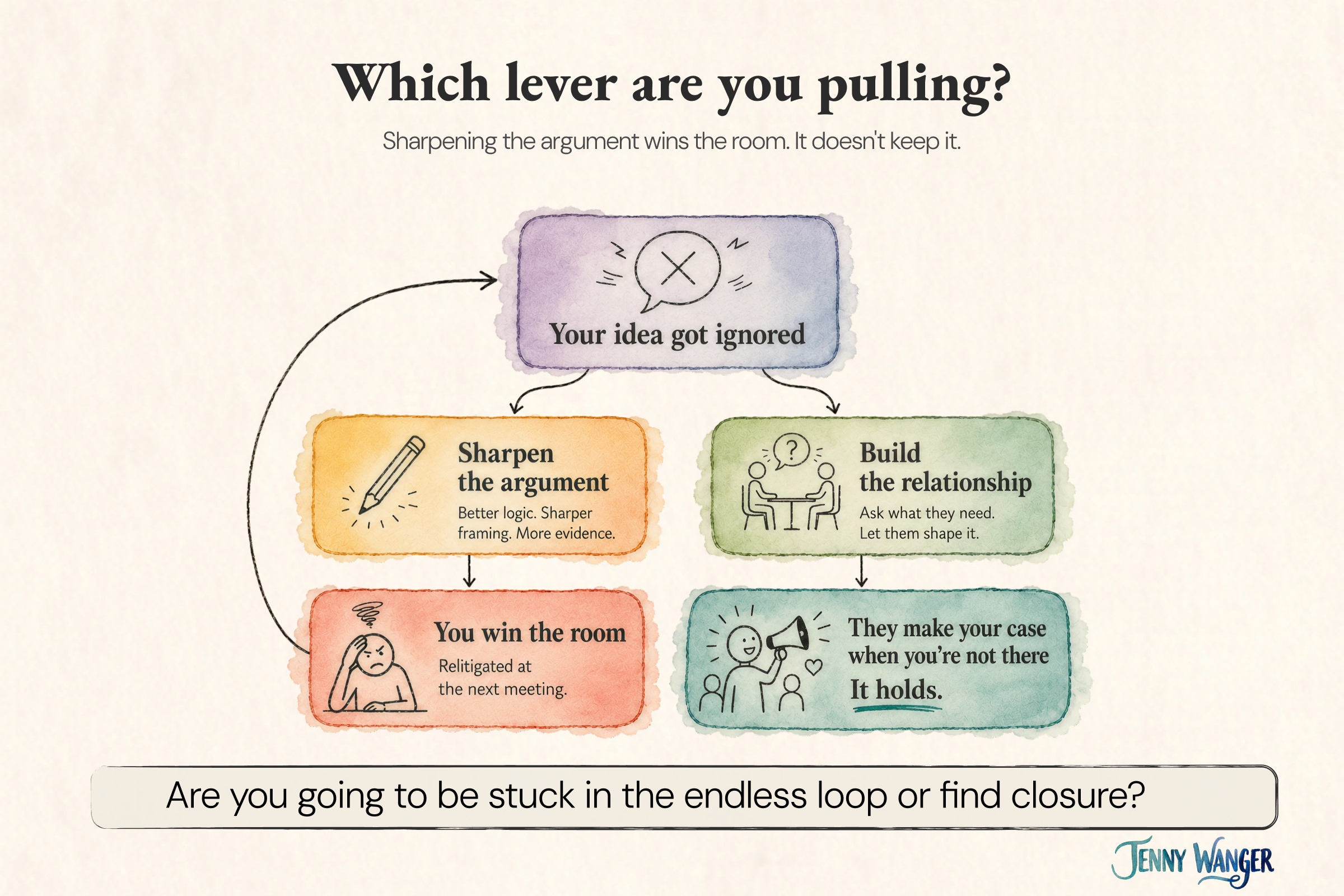
Their first instinct was to sharpen the argument: better logic, better slides, more evidence. Reach out to the ignoring exec ahead of team meetings to present their arguments. If they could just make the case tighter, surely the exec would hear it this time. It was the wrong lever.
When sharpening the argument didn’t work either, they landed on a theory I hear from almost every person I coach in this spot: the real problem was title. That exec outranked them, and that was why the exec always listened to the CEO but not them. If they just made Sr. VP, or CPO, surely people would start listening to them too.
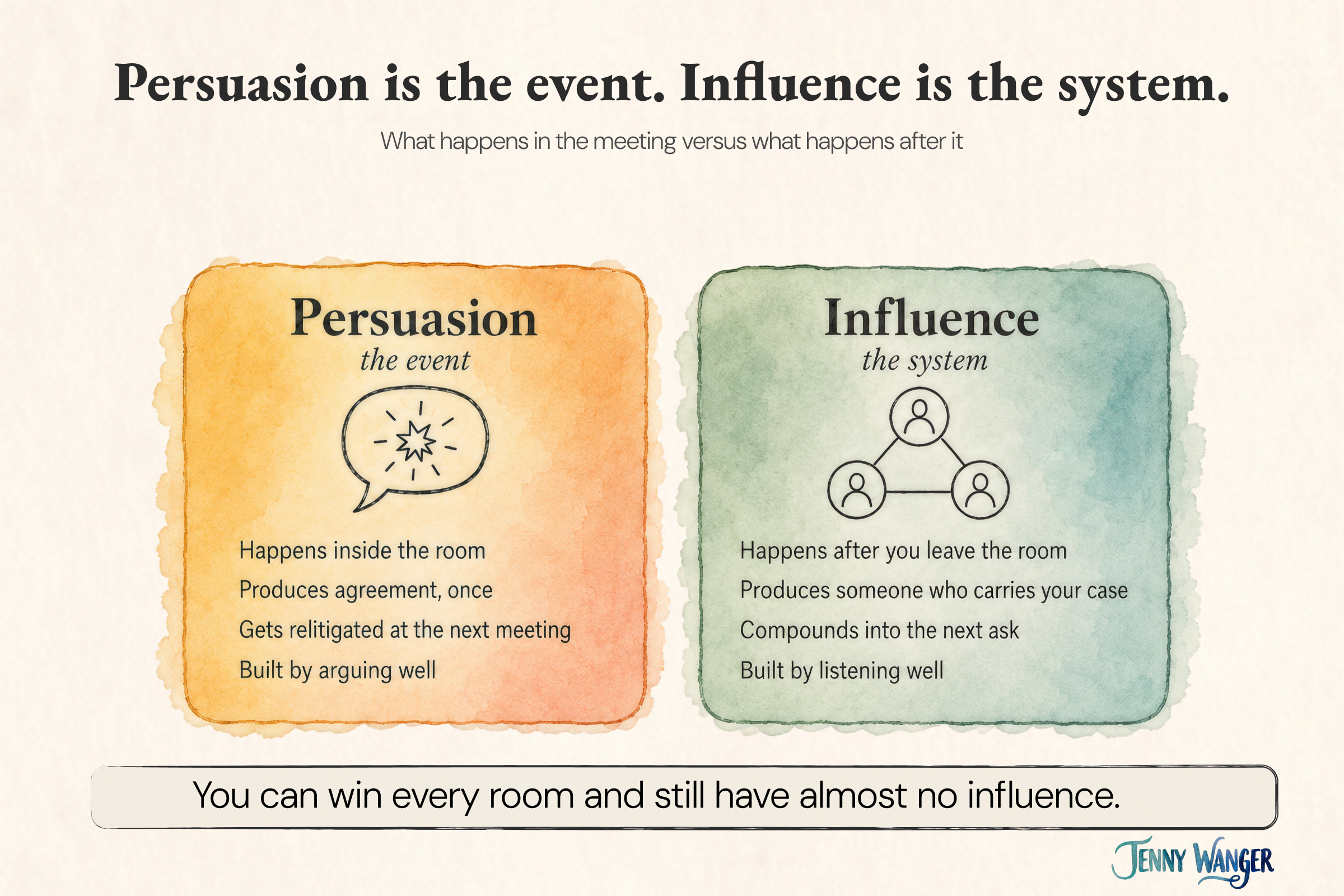
Persuasion is the event. Influence is the system.
Persuasion is what happens in the room. You make the case, and the person in front of you either agrees or doesn’t, right there, based on how well you argued it. It’s a single event.
Influence is what happens after you leave the room. It’s whether the person you persuaded goes on to make your case to people when you’re not there, because they’ve decided supporting you is the right call. Influence is the system that makes your next persuasion event easier to win.
That distinction matters because you can be very good at persuasion and still have almost no influence. You can win argument after argument in the room and watch every one of them get relitigated in the next meeting. If every idea has to survive fresh persuasion each time, you don’t have influence.
Influence is reputational. It’s the standing you build over time as someone who thinks clearly, listens seriously, and will really listen to others, not just be polite about it. You gain influence by proving you care about their goals, not just your own.
That head of product had this backwards. They thought a bigger title is what would finally get them heard. Over time, they realized it was the reverse: influence earns the promotion, not the other way around. If your voice is getting ignored now, no promotion is going to fix that on its own.
Where I over-indexed on persuasion and it cost me
Early in my career at SpotHero, one of the things that made me good at the job was sweating the small details and looking far enough ahead to catch a little issue before it became a big one. In one meeting, right before lunch, I saw something in how a certain set of properties were being attached to other objects in the system that I thought would turn into a real, expensive problem later. I wanted the engineering team to see it too. I went to the whiteboard and started mapping it out. I asked each engineer to walk me through their reaction. I stayed at the board.
Eventually one of them handed the marker back to me and said something like “fine, whatever, I’m just going to go eat.” I “won” the meeting. I persuaded them. A few weeks later, they went and built what they thought was best anyway, a version that was probably better than what I’d been arguing for. I didn’t have influence.
The instinct to catch it early was right. How I handled the room wasn’t. I burned credibility on something that didn’t ultimately matter that much, in a rushed pre-lunch meeting where nobody had the bandwidth to engage.
I was holding on too tight to being the one who’d spotted the problem, because I didn’t trust my engineers enough to let them work it out themselves. I got the persuasion “win” and a dent in my influence in the same afternoon. Looking back, I was a bit of a bully that day.
That pattern is what eventually cost me a promotion at SpotHero: I kept over-indexing on being right, then handling the room so badly that whether I was right or not stopped mattering. (Longer version on Andrew Capland’s podcast.)
That’s what happens when persuasion is the only tool in the box. You can technically get people to agree in the moment and still lose ground on whether they’ll listen to you next time.
What influence looks like when it works
Years later, I was brought in to help a fintech founder-CEO who was functionally running the product team. This time, I led with questions instead of the whiteboard.
When I joined, there was no articulated product strategy. Everyone had a different perspective on where to play, and that division was showing up in weak product delivery.
I ran discovery interviews with everyone I could: engineering, sales, ops, the executive team. Every stakeholder had a chance to shape the picture I was building. By the time I sat down with the CEO to walk him through what I’d found, everyone felt heard. He agreed with my proposed direction. One meeting. That was the persuasion event.
But the influence work had started weeks earlier, in the discovery interviews. Everyone who’d felt heard in that process already trusted the picture I was building, which is why the CEO didn’t need extensive convincing. He’d already watched me get it right with the people who knew the business best.
For a couple of months after that meeting, the CEO would surface new ideas that didn’t fit the strategy. “What if we did this instead?” Instead of reopening the strategy from scratch each time, I’d ask two questions: does this get you to the goals you’ve said you want? Is it more important than what we’re already doing? We’d have a short back-and-forth about the tradeoffs, and conclude, together, that staying the course was the right call.
Critically, we’d agreed on the goals up front in that first meeting. When he found a new idea to explore, my job wasn’t to fight him on it. My job was to keep pointing at the gap between what he proposed and what he’d already said he wanted, and let him close it himself.
A couple of months in, other people started bringing him ideas outside the strategy. He started saying no without me there, using the reasoning we’d built together. He didn’t need me in the room to hold the line. That’s influence.
The persuasion event was one meeting. The influence took weeks of discovery beforehand and months of small, patient conversations afterward.
Sometimes the point isn’t to win
At Linux Foundation Public Health (LFPH), I believed the org needed to broaden its remit: pivot from a pandemic-specific mandate to a broader healthtech mandate, something with room to survive the post-pandemic funding environment. I brought the case to the board, explained why I thought it could help us thrive in the future, but I wasn’t expecting them to say yes that day. A change that big wasn’t going to happen on the first ask.
By the time I brought it, I’d already invested in building relationships with the board: showing up prepared, listening, becoming someone they had already learned to trust. What came next built on that foundation.
I was bringing them an argument I expected to lose. Best case, I’d get a “not yet.” Worst case, a flat-out no.
I tried to persuade them. As expected, the board said no and I let that be the answer. They also opened a door: here’s why now isn’t the right time, and here’s when we might revisit.
I went on maternity leave not long after, then left LFPH before the reconsideration window came around. I never found out if the board would have said yes the second time.
The move was still right. Accepting their timing instead of fighting it was what told the board I cared about the org’s interests, not just mine. Had I tried to push for a decision before my maternity leave, I would have been signaling that I cared more about my career than the organization. I extended that trust without ever getting to collect on it myself.
Why letting yourself be influenced builds influence
None of this works without one thing underneath it: trust has to run in both directions. In the fintech story, people trusted me because I’d spent weeks proving I was tracking their goals, not mine. At LFPH, the board trusted me more after I fully accepted their “no” response on their terms.
In both cases, the influence wasn’t something I earned by being persuasive. It was something I built by being persuadable, in front of the people whose trust I needed.
That only works if two other things are already true: you show up the same way often enough that the trust has something to attach to, and you come to the relationship curious about what the other person needs instead of waiting for your turn to make the case.
Being persuadable isn’t about whether you turn out to be right. At SpotHero, the technical call might have been fine. What cost me was how hard I pushed to make it stick instead of trusting my engineers to get there themselves. At LFPH, I never found out if the pivot itself was the right call, and it didn’t matter. What built trust was letting the board’s timeline stand instead of pushing past it. The test isn’t whether you were correct. It’s whether you let anyone besides you decide how it plays out.
How much do you lean on persuasion versus influence?
If your ideas keep getting ignored, the temptation is to sharpen the persuasion. Better logic. Sharper framing. More evidence. Say it again.
But what I’ve found over and over is it’s better to dive into influence, which means relationship-building. Look at the last time you got resistance: a meeting, a comment on a doc, a proposal that died due to nobody really pushing it forward. Did you sharpen the argument, or did you step back and think about the relationship? How much of your last week was spent making cases you needed to win, versus showing that you were caring about others’ goals?
If the answer is “almost all of it was making arguments,” you already know which lever you’ve been pulling. The other one is still sitting there, unused. Put the argument down, and go find out what they need instead.