
What to do when it comes up in your 1:1
This is part 2 of a 2-part series. Read part 1: Burnt out on a three-day week
“I’m so busy I haven’t had a chance to think about how to actually do it better.”
Someone tossed that my way near the end of our 1:1. It sounded like a complaint about their calendar. Every product person I have ever managed has said some version of it, and most of the time they are busy. Welcome to product management.
I made a note to talk about priorities and time management next time.
But as I thought about it more, I got the sense that this requires a different kind of attention.
I’ve heard some version of this throughout my career, as have most product leaders. Sometimes the comment arrives with the label attached.
“I’m overwhelmed.”
“I think I’m burned out.”
And sometimes they don’t say anything at all. Yet they look tired in every meeting. The energy has disappeared when they talk about their own work. They’re seeming disengaged in an almost-dejected way.
You noticed. The first feeling that comes up is alarm. This is someone you rely on, someone you would have real trouble replacing, and they’re now a flight risk. That’s worrying about yourself.
Then you start to think about their experience. Logging on every day and dreading it. Feeling tired, some kind of brain fog. The emotional weight of what they’re carrying.
You want to help, and you don’t know how.
Lessening the workload isn’t a real option
The default is to lighten their load. Ask about workload. Cancel some meetings. Suggest they take PTO. Encourage better boundaries. It’s standard enough that it barely registers as advice.
This creates problems.
One problem with it is you still have goals to hit and work to do as a product team. Having one person working lighter than the rest creates inequities and risks resentment that you don’t want to encourage.
The other problem is that lightening the workload frequently doesn’t work for them.
Last week I wrote about the kind of burnout where rest doesn’t help: the exhaustion that comes from the gap between who someone believes themselves to be and how they’re showing up at work.
The data backs it up. In Evie Brockwell’s research with Product Academy, 72% of product people who’ve experienced burnout have experienced it more than once. If rest were a good answer, the return of the burnout would be rarer.
So here’s what I do instead, in the coaching chair, when someone brings me phrases like these.
I’m not a mental health professional, and nothing below is clinical guidance. It’s what I’ve done and watched work with a number of product leaders. You must flag when they need better help than you can offer.
You can also try these same steps on yourself. I’m writing for the manager, but if last week’s piece described you rather than someone on your team, try these questions as a self-reflection.
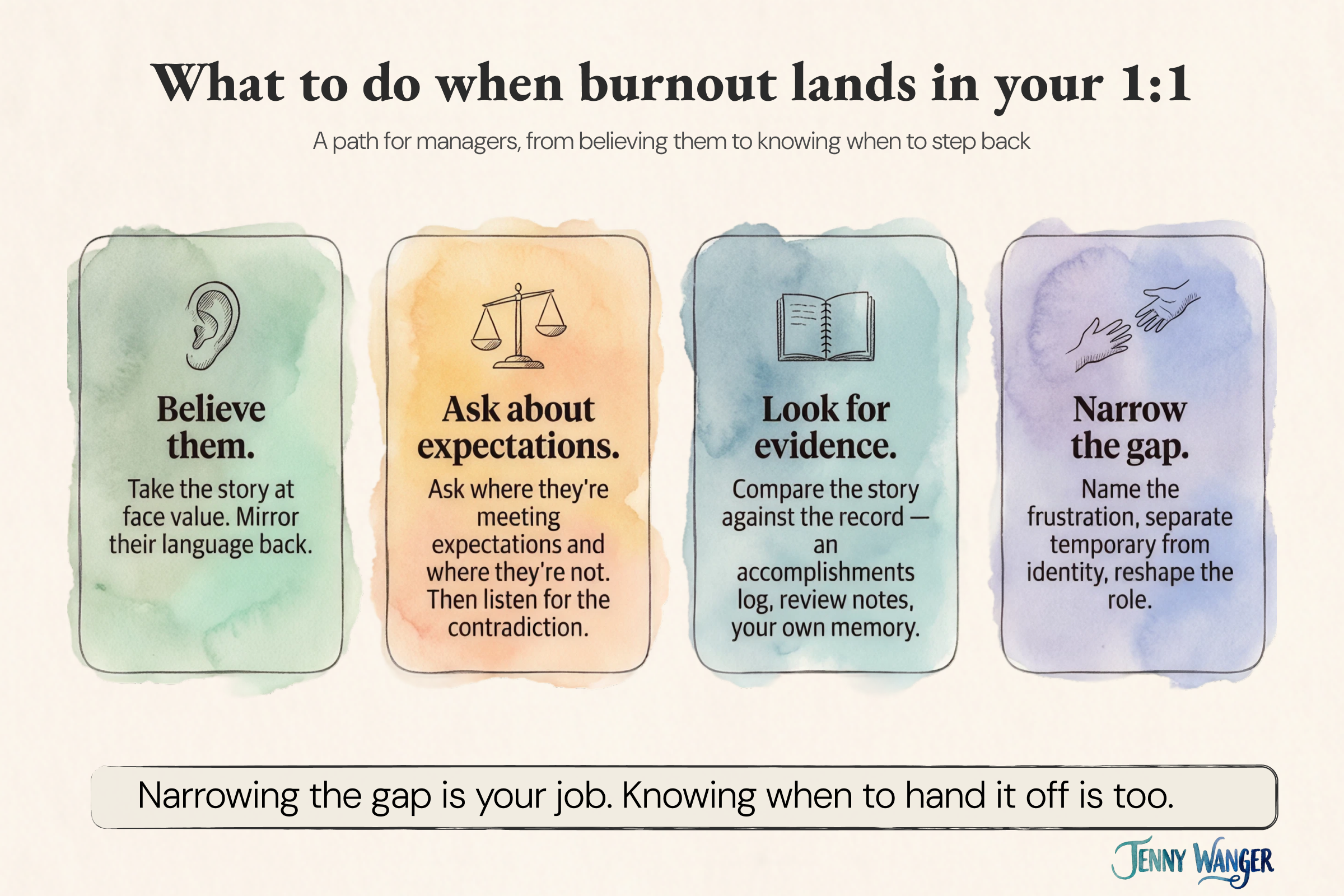
Believe them
The first move is an acknowledgment.
Burnout is real. And if they’re scared that the person responsible for their professional growth doubts them, it creates additional layers of challenge.
If they’ve used those terms with you, then mirror the same language back. If you’re worried they’re burned out and they haven’t said those exact words, ask questions about their experience and wellbeing to see if you can find their language.
That has to come first because some people who are burned out also experience shame about feeling burned out.
Brockwell’s research puts a number on that too: 43% of product people say burnout is a taboo topic at work.
Once you’ve said it, stop talking. Let them steer the next few minutes of the conversation and confirm that they are willing and ready to talk about it.
Ask about expectations, then listen
Once they’re ready to talk, there are three questions to move the conversation forward. Make it clear this isn’t a performance review. All of them are about internal and external perceived pressure:
- Where do you feel like you’re meeting your own expectations?
- Where do you feel like you’re not living up to them?
- Where do my expectations, as your manager, add pressure? Or where do you feel like you’re not meeting those?
“How do you see yourself? Any internal contradictions?” is an enormous and abstract question to toss into a conversation. Meanwhile, many of us are already carrying a running inventory of where we think we’re falling short, making these three questions easier to answer (hello, high-achieving product managers).
The third question requires you to be vulnerable. It puts your own expectations into the room as a possible source of the pressure, which gives your report permission to be more candid.
In coaching, I’ve seen a lot of my clients mention the pressures their manager is putting on them. But when we peel it back a little bit, it turns out those were fabricated expectations. (I’ve done it to myself as well.) As a manager you can say a small thing and the person hearing it can blow it out of proportion.
Once you’ve asked, again it’s time to listen. What you’re listening for is two things that can’t both be true.
In the last article I introduce Maya who was on the job hunt. She gave me a version of herself as a high performer, and in the next breath told me she was on autopilot at the startup (“I’m holding back over there. I’d rather prioritize my energy on the job hunt”).
I also talked about Jordan, who described himself as a builder and a get-it-done person, and in the same conversation described his work as something happening to him.
Neither of them said “I’m misaligned.” They said things that contradicted each other.
When you hear the collision, stop working the question list and dig in. Say it back to them in their words.
Then stop talking and wait patiently (stopping and letting them speak is a theme here). They’re deciding whether to agree with your observation, and they need to get there at their own speed.
Look for evidence against the story
Once someone is living in that gap, they’ve built a narrative about themselves full of confirmation bias. So the next move is to evaluate the stories against the truth.
For Jordan, that meant an accomplishments log: writing down what he’d done over the previous quarter. His narrative was “I’m not adding value.” The record disagreed. He didn’t get to the transformation he’d wanted to lead, but there was a lot he’d done and subsequently decided “didn’t count”. We walked through those to reevaluate if those wins should be so easily dismissed.
Maya’s version equated the interview pipeline with her performance. She’d accepted job rejections as a verdict on her skill set. Over a decade of building and running teams was sitting right there, discounted.
As their manager, you can bring your own data too. You have review notes, project history, feedback from the rest of the team, and your own memory of the year. You can say “from where I sit, here’s what actually happened.”
One risk is that you skew the bias the other way, lingering too far on the wins without acknowledging the misses. This is an opportunity to be balanced and truthful. They need to trust you and the data.
Narrow the gap
At this point you’ve got a hypothesis about what’s causing the burnout symptoms. Now it’s time to figure out how to narrow the distance between who they are and how they see themselves.
Again, ask permission to move into this space with them. Don’t force these questions on your report if they aren’t interested. As their manager, they’re already going to feel pressure to say yes and be more agreeable. Give them the out.
It might take a few different approaches. Jordan used most of these.
Look directly at the emotional state. At one point Jordan admitted he’d been too busy to look at the frustration and disappointment underneath it all. Naming them out loud seemed like it would be a waste of time. But we tried it anyway, and saying it out loud was the first real unlock to seeing the other side of his burnout. He realized that staying silent about it just let it fester instead. The negativity was building on itself. (Maya also had to admit what was going on to start figuring out how to move forward.)
Define what is temporary and what is enduring. “Until I have the right team to support this scope, I’m going to be doing the operating rhythm work instead of the transformation.” That sentence moved him from “this is who I am now” to “this is where I’m at right now.” We shifted the conversation from a self-definition to a situational assessment. That created space for some conversations without self-criticism.
Reshape the role to better fit the person. Jordan worked out that getting unstuck from the operating cadence meant articulating how under-resourced the transformation work was. He took the opportunity to push, strategically, for staffing the company goals effectively. He made the business case, got headcount, and his report returned from parental leave. With each person he’s onboarded, he’s been able to focus more on the team changes instead of keeping the lights on. The role changed, not just his attitude toward it.
Sometimes the role is not a fit. As a manager, we also have to have the conversation about whether the role itself is a fit. There may be enough factors to realize that this person can’t be set up to succeed in this environment. The kindest thing to do at that point is talk about different opportunities. (and it really, really sucks)
With these steps, in Jordan’s case, the work went from something being done to him to something he gets to do. In his words, he’s “returning to the person I want to be.”
And I’ll be honest, it isn’t a total cure. But if Jordan finds himself saying “I’m too busy to be disappointed about X,” he catches it now as an anti-pattern. We talk through those moments more in coaching. He’s figured out that self-advocacy is a major part of what makes him feel agency in his role, and so he’s been standing up for himself more.
In other words, he has a toolkit.
As the manager, your job through this is thought partner, not fixer. Some of these you can help with directly (Jordan’s hiring case was a business argument that needed a sponsor). Some of them you can only encourage (you can’t force them to name their feelings, or tell them what they’re feeling).
The limits of your seat
You are the manager, neither an uninterested third party nor the person living with symptoms of burnout. And you have to reckon with what it means to be in that seat.
The first is that you’re inside the dynamic. I have no political stake in how my clients show up at work. You do. You’re their manager, you’re invested in a particular outcome (they stay, they leave, they take the role, they don’t), and that stake shapes what they can tell you.
When someone hands you a clean external explanation (the calendar, the reorg, the headcount), take it as the first layer rather than the whole account. And if the deeper version turns out to involve you, don’t get defensive. Accept their explanation and be on their team.
And sometimes the best thing you can do is help them get better help than you can offer. None of the moves above substitute for clinical support. Hand it on to someone better equipped when:
- The exhaustion has moved past work. “I’m having trouble falling asleep because work is in my head all the time.” Sleep, health, pulling back from things outside the job.
- Anything that sounds like a person in crisis.
- If a topic surfaces that your employer is obligated to act on: harassment, discrimination, a medical accommodation, leave. That goes to HR immediately. Running a coaching conversation on top of one of those can do real harm, to them and to the company.
- You’ve tried these moves and nothing shifts. Whatever is going on is bigger than a gap the two of you can cover in a 1:1.
Then have the next step ready. Know where your company’s EAP or mental health benefit lives before you need it, not during the conversation. Bring HR in early rather than late. And tell the person plainly why you’re doing it. Handled well, none of that is a betrayal of the 1:1. Handled clumsily, it is.
Escalating doesn’t end your part, either. You’re still their manager. The workload conversation, the role-shaping conversation, and the “I’m glad you told me” all still belong to you.
Back to where this started
Jordan mentioned burnout on a coaching call.
Believing him came first.
The expectations questions are what turned up the contradiction: a builder, a get-it-done person, describing his own work as something happening to him in the same breath.
The accomplishments log is what turned “I’m not adding value” from a verdict into a question. The log was full of decisions he’d made and outcomes he owned that he’d stopped counting.
We narrowed the gap with three moves: naming the frustration he’d been letting stew, separating what was temporary from what he’d started treating as identity, and making the business case for headcount so the transformation he cared about had a real shot.
What all three turned up, in the end: he wasn’t too busy to think about how to do the job better, and he didn’t really need a break. He just felt it was unproductive to admit he was frustrated. Grinding through instead meant he felt his own bar had slipped.
Swallow the frustration, feel like you’re letting the standard slip, feel worse about the work, repeat. Talking to me about this is most of what got him out of it. In his words, that’s what let him start “returning to the person I want to be.”
Because of the sensitivity of this topic, I have changed names and key details of each person mentioned in this article.
If any of this is landing somewhere heavier than reflection, if you’re dealing with depression, anxiety, or exhaustion that reaches past your work, please talk to a mental health professional. Coaching is built for the “I recognize this pattern and want to think it through with someone” moment. It isn’t a substitute for therapy or clinical care.