
The 15-minute monthly habit that shaped my career pivot
A few years ago, I decided to leave my in-house role and go independent. I’d done a values exercise where freedom and flexibility came out on top. Working for myself was the obvious answer.
What wasn’t obvious was the niche. “Product management consulting” was too vague. It could mean anything to anybody. So I went back to my accomplishments log.
Since my first product job, I’ve been keeping a monthly list of my wins — three or four bullet points, ten minutes at the end of every month. I’ve also been collecting praise: Slack messages, emails, or quotes from a stakeholder that recognized something I’d done. Screenshots, mostly. The whole thing started because Steph Ryter, the kind of professional aunt every early-career person should be lucky enough to find, taught me to keep a file. So I did.
Most senior leaders don’t have that longitudinal career data when they need it. They hit a transition and try to reconstruct it from memory. At senior levels especially, the wins become more diffuse — you navigated a political situation, you built a team that hit its stride, you unblocked a stuck initiative. There’s no clean feature launch with a dashboard to point to. And even the details that do exist — the exact words someone said, the context of what you changed, the proof that something shifted — fade fast.
By the time I was making this decision about going independent, I had the data going back to 2017. I sat down and read through it.
I was sure the through-line was going to be product building. I’d shipped features. I’d led launches. The story I told about myself was that I was someone who got products out the door.
But that story didn’t match what I was most proud of. What I got the most compliments for.
What I saw, scrolling back through years of wins, was systems and culture. At SpotHero, it was the PM new-hire onboarding, the roadmapping process I’d redesigned with the executive team, the internal talks that had quietly reshaped how other functions worked. At the Linux Foundation — where I had no authority over anyone (you can’t tell open-source contributors what to do) — the work I was proudest of was the structure I put around welcoming in new open-source projects.
Product launches were on the list, but they weren’t the spine. The spine was the systems work, the work that changed how a team thought about itself. I knew I liked culture. I hadn’t realized how completely it was tangled up with building processes in everything I did.
That pattern became my consulting positioning.
Here’s how I run my accomplishments log system – nearly the same process I’ve been running since Steph first taught me.
Creating your general ledger of accomplishments
The accomplishments log has two parts: an actions log and a praise log. Together they take about fifteen minutes a month to maintain. The format doesn’t matter. Mine has lived in Excel, then Google Sheets, then Coda, and at some point it’ll move again.
The idea behind it is to create a record of your work: the accomplishments you’ve had, metrics you’ve hit, and projects you’ve enjoyed. The praise log highlights the wins others have seen you do, and the actions log highlights the moments that you think are worth remembering.
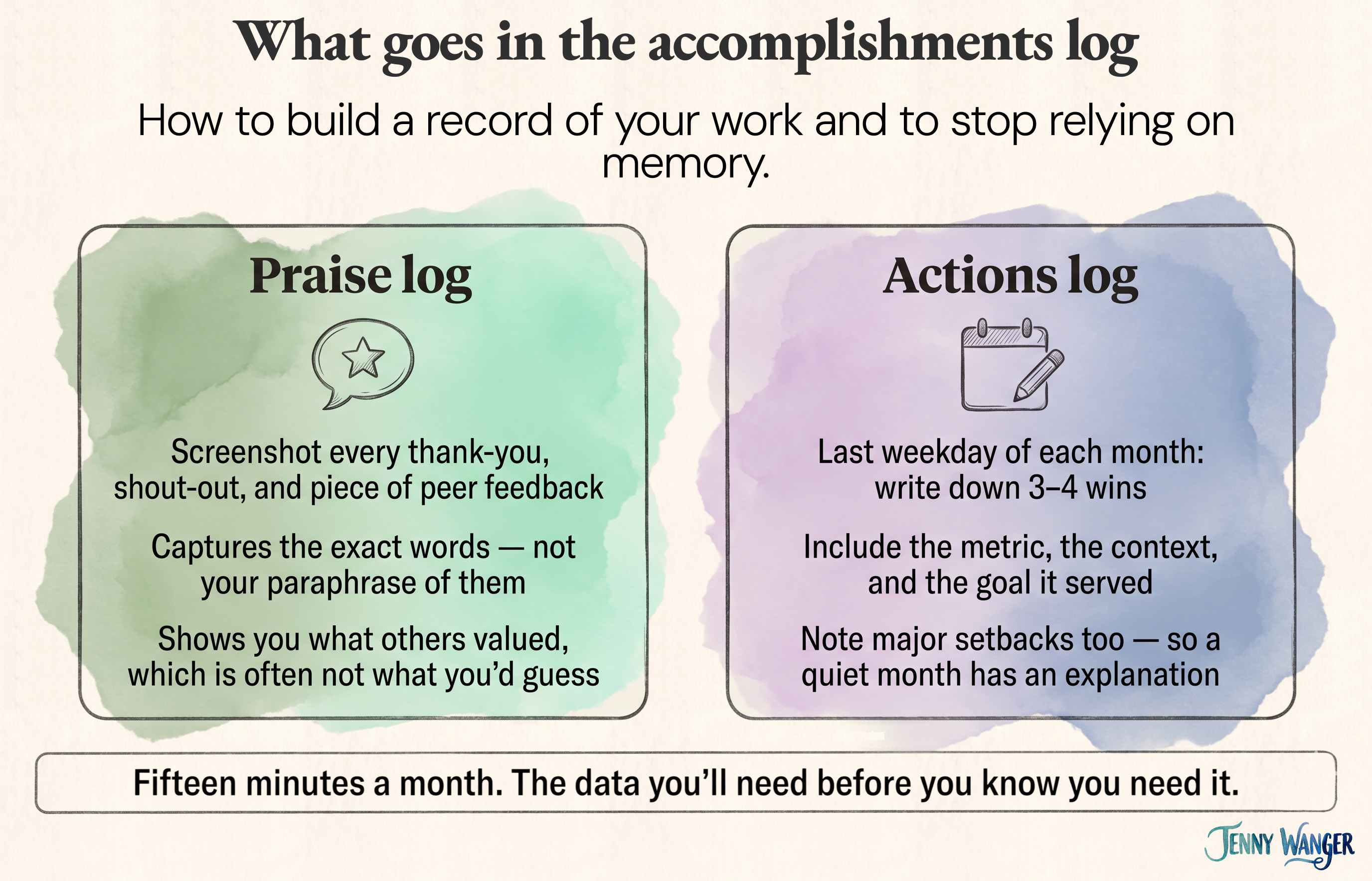
What others say about you: Praise log
My brain keeps better records of what went wrong than what went right. The embarrassing flubs, the difficult conversations — those (unfortunately) stay sharp. Meanwhile, the wins fade or I discount them: that wasn’t really me, that was just luck.
The praise log is the counterweight.
Whenever someone sends you a thank-you or a shout-out, screenshot it and file it away. It might come from anywhere: a Slack message after a tough meeting, an email from a stakeholder, peer feedback from a review cycle, a passing comment from your CEO.
I screenshot mine because the screenshot carries the exact words in a way that paraphrasing never will and reminds me that it’s authentic. “Ben said I was helpful to the Platform team” is not the same as the screenshot that’s been in my praise log since 2019:
“Over the past few weeks Jenny has jumped in to help the Platform team in a number of areas. First, she’s volunteered to help us review our roadmap and reevaluate our priorities, outside of her day to day responsibilities. This help has been critical in helping us reevaluate our priorities and question some stale assumptions. Jenny has also been putting herself through the engineering onboarding process in an effort to help us understand what is working and not working. Her documentation of that experience will be indispensable for us as we revise the onboarding experience ahead of a surge in engineering hiring. Finally, Jenny also provided important feedback on our latest V2 API designs which were helpful in identifying areas where our language was unclear or were conceptually malformed. Thanks for going above and beyond to make sure that the overall engineering and product teams at SpotHero continue to do a great job!”
— Ben Goldberg, SpotHero
What I would have remembered: something vague about talking to Ben around a decision he was facing. Not three specific contributions. Not those words.
Memory fades unevenly. The hard things stay sharp; the good things blur. And even when you do remember, you’re remembering your own version — what you thought you were doing, not what landed for the other person. The praise log is the only way to get that other version. Over years, it surfaces your own strengths more accurately than any amount of self-reflection can.
What you say about yourself: Actions log
Metrics are harder to retrieve than you’d think. You improved conversion on a key flow, you hired someone who ramped in record time, you hit a milestone that shifted the team’s trajectory. Six months later, the exact number is buried in a dashboard you no longer have access to, a Slack thread you’ll never find, or just gone. Capturing it in the moment is the easiest way to have it later.
That’s what the actions log is for. It’s an investment in being able to tell your story — specifically, precisely, with the numbers still attached.
On the last weekday of each month, I set aside a ten-minute calendar block and write down three or four wins. One lesson I’ve learned over time: don’t just write the win down, but to connect it to a goal I was pursuing and add enough detail that I can look back years later and know what I was talking about. For example, a few years ago I wrote down that I “delivered the premortem workshop.” I didn’t write down who I did it for, why it was happening, or what came of it. Luckily, I can piece that one together, but I’ve learned it’s better to just write down enough detail in the moment.
I format it as a table with a few columns: what I did, what month it happened, how it connected to my goals, and any additional notes. Very simple. Each accomplishment gets its own line in the table.
I also capture significant setbacks as context. If I was sick for two weeks, if a market shift blew up the roadmap, if a reorg consumed the month, I’ll note that. The reason isn’t to dwell on what went wrong. It’s so that when I’m reading back through years of entries and hit a month with almost nothing in it, I know why. Without that context, I’d be left wondering what was wrong with me that month, when the answer was just life.
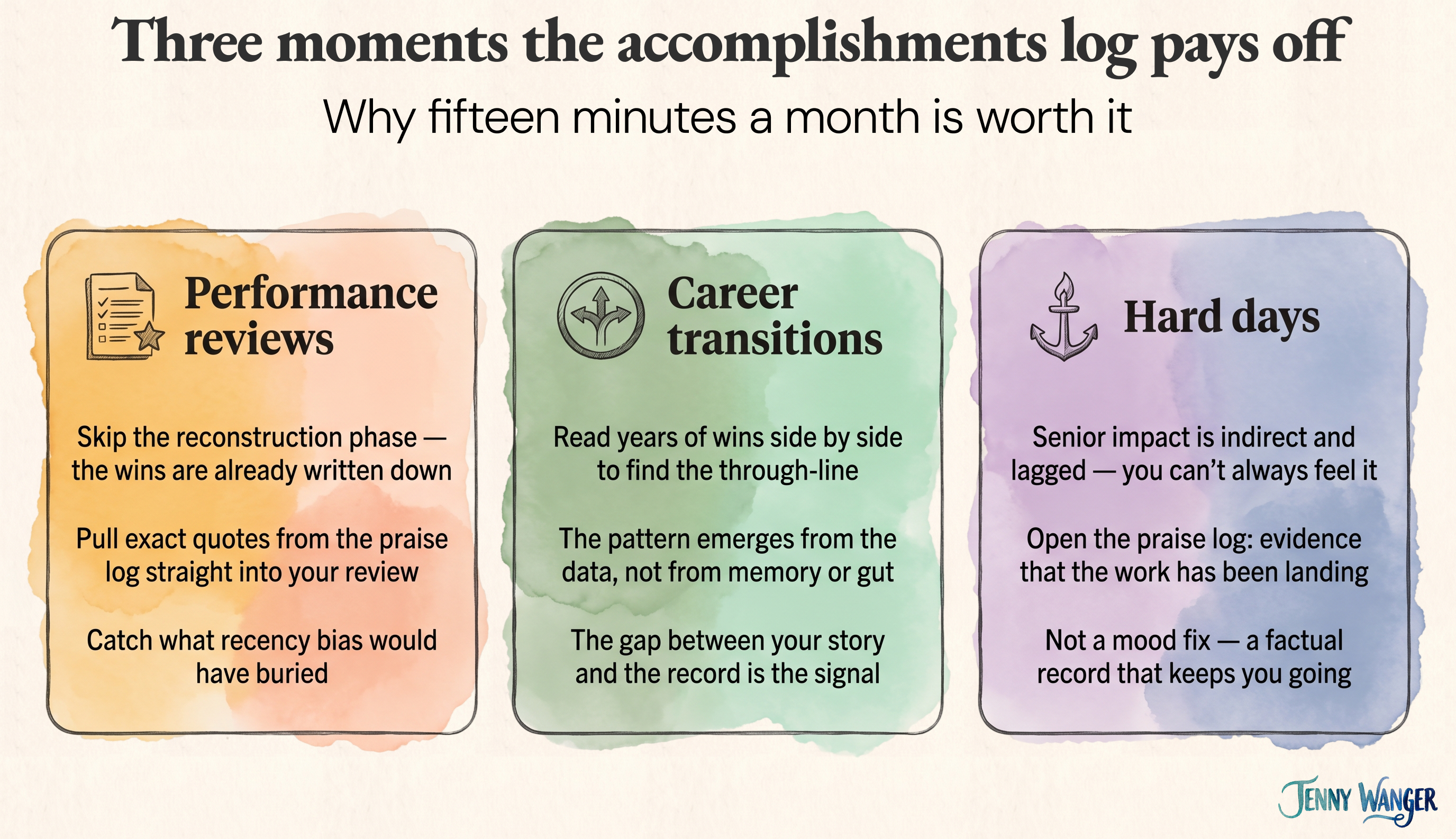
Compiling the logs is the first thing, but then the question is where to use it. Once you’ve got this data, you’ll find a number of different places where it’s extraordinarily high value. I found it so useful when it comes time to performance reviews, writing resumes, and we’re making career pivots. And it’s something very nice to have on a rainy day.
This takes some of the stress out of performance reviews
You can keep the accomplishments log for years before you ever do the big career-pivot exercise I did when exploring consulting. Long before that, it earns its keep every review cycle.
When preparing for an annual review, most people spend the first chunk of their prep just trying to remember what they did. Digging through old emails. Skimming Slack. Looking over their calendar.
The accomplishments log allowed me to skip that step. The stories were already there with the specifics intact. The praise log had exact quotes I could pull in.
This let me jump to the framing phase — deciding which stories made the strongest case, how to position them, and what to emphasize. That’s where the actual leverage of a performance review lives.
It also corrects for recency. One spring at SpotHero, my mind was fixated on a difficult incident from December, just a few months prior. My accomplishments log showed I’d led a major product launch the previous summer. I almost glossed right over it. I caught myself, pulled the launch into focus, and built the review around it. The December incident still got addressed. It just stopped overshadowing everything else.
The same is true for resumes. Most people update their resume reactively, when they’re already in job search mode. But if you’ve just been let go, you’ve also just lost access to the data: the dashboards, the Slack history, and the emails with the numbers in them. I’ve been there. The accomplishments log was what I had left. Every specific I could put on a resume was already written down, from before the door closed.
In both cases, the value is the same: you’re not reconstructing. You already have it.

Finding your through-line
Performance reviews are the immediate return. But if you keep up this habit for years, you see even more value during the major transitions.
When I was trying to figure out if I should go back into consulting, the values exercise told me how I wanted to work: independently, on my own terms. My actions log told me what I should actually be doing. They showed me a pattern about myself that I couldn’t easily see otherwise.
I pulled out the wins I was proudest of. Looked at them together. What gave me energy? What kept showing up? What kind of work did I keep choosing, even when nobody asked me to?
I now advise the senior product leaders I coach to keep their own logs. Sometimes we go through it together to create a clear pattern of their strengths over time.
The answer might not match the story you tell about yourself. Mine didn’t. I thought my strength was as a product builder. The accomplishments log said systems and culture. That gap between identity and reality is the thing the wide-angle view exposes so well.
Either way, you’re making the decision with data instead of gut. And as product people, how could we ask for anything more?
The hard days
There’s one more thing the praise log does that I didn’t expect at the beginning.
On the days when it feels like nothing is quite right, I open the praise log. Not to feel better in some abstract way, but because the evidence is right there: even on the days that feel like everything went sideways, the log is still being written.
At senior levels, impact is indirect and lagging. The conversation you had today won’t show its effect for weeks or months, if at all. You just have to have faith you’re headed in the right direction. The praise log is external evidence that the work has been landing, even when you can’t see it immediately. And that can help you keep going, despite the challenges of leadership.
Start before you need it
The accomplishments log only works because it exists before you need it. It’s near-impossible to build the data retroactively.
Fifteen minutes a month. A recurring calendar block. Whatever format is easiest to maintain. Don’t over-engineer it. Just start.
Mine has been running since my first product job, and that depth is what made the career pivot as clear as it was. I had years to scan when the moment came.
You can’t see the pattern from the short term of what has happened recently. That’s not a flaw — it’s just how our brains work. The value of the log compounds over time, and the only way to have it later is to capture it now. Three months in, it’s a short list. Three years in, it starts to tell you something you might not otherwise notice.
The story I told about myself was wrong. Not entirely, but enough to matter. I found that out because I had the data. Start collecting yours.
If you want to try an AI version of this, Alexandre Cartier built a skill to run as a routine. I’d recommend still doing it yourself too, but an automated supplement might catch some things that you’d otherwise miss!
Want articles like this in your inbox? Subscribe to The Next Iteration.