
Being stuck is a sign you’re wearing the wrong hat.
Corinne (not her real name) just got hired as head of product at her company. With the role has come something new for her: a seat on the executive team.
A manager mentioned in their regular cross-functional check-in with Corinne that they weren’t getting the support they wanted from their executive, one of Corinne’s peers, on a sales project.
During our coaching session, Corinne walked through her plan. She would encourage that manager to bring up the sales project in a meeting she and the other exec already attended. Then she could publicly back the manager and nudge her peer to give the project more support.
I pointed out that the manager could raise it anywhere but had come to Corinne for help. And for Corinne, there were executive team dynamics to consider. “Is this actually the move you want to make?”
She was quiet as she thought it over. Then: “Dang it!” I asked why that was her reaction. “Because I don’t think it’s holding me accountable to using the executive team as my first team.”
We laid out more options, and she got stuck choosing among four of them:
- Say nothing and let it slide.
- Go to the CEO (AKA her manager).
- Put it on the executive team agenda.
- Talk to him about it directly.
None of the four felt particularly appealing.
Each option is a different hat
Corinne wears two hats now. As head of product, she represents her department. As a member of the executive team, she represents the company alongside her peers, what her CEO calls her first team. Each option on her list meant acting as a member of one team or the other.
We walked through the four and asked what dynamic each one would be the right move for. We then reasoned through why she was reaching for that hat in this particular situation.
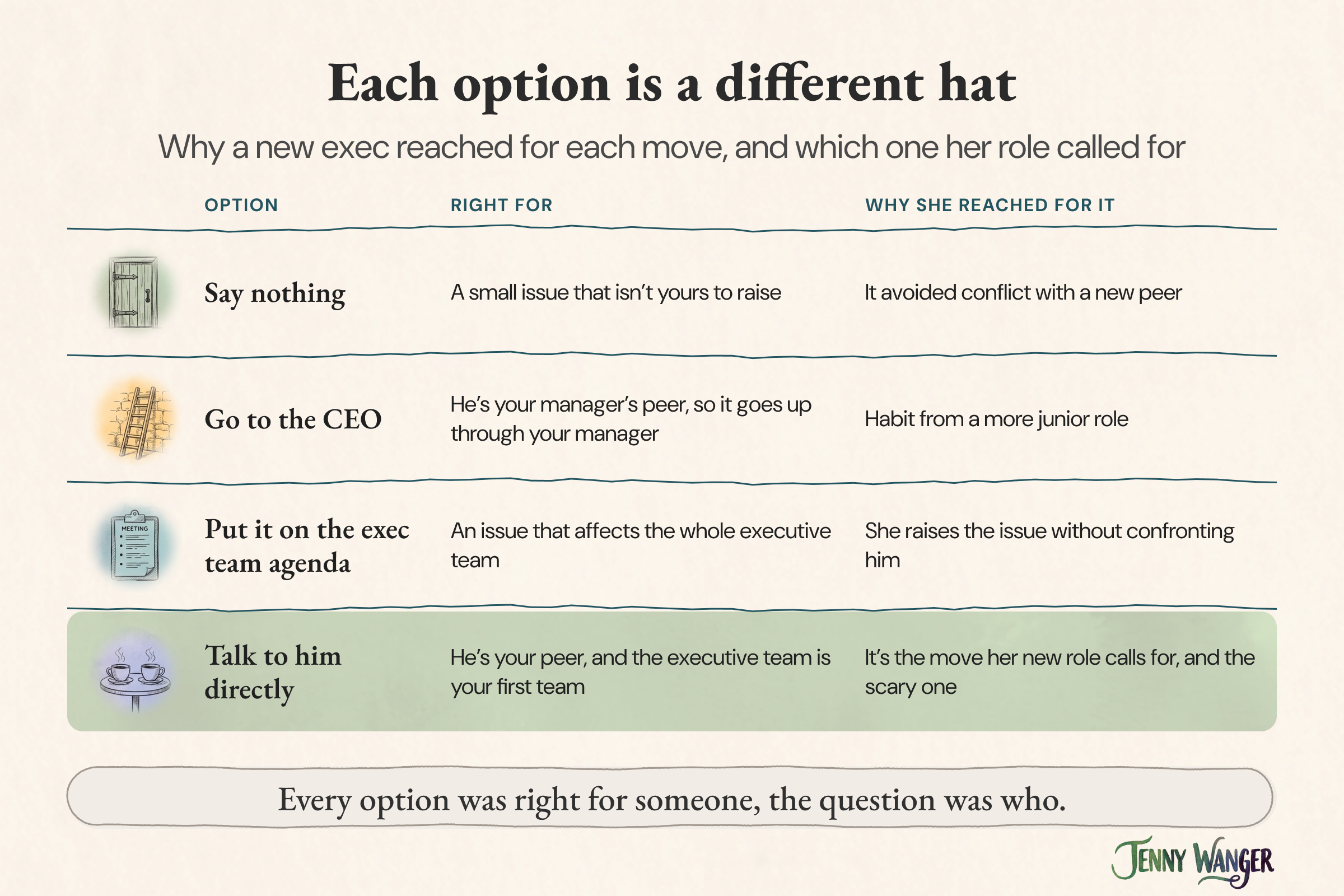
| Option | The dynamic it’s right for | Why she reached for it here |
|---|---|---|
| Say nothing and let it slide | A small issue that isn’t yours to raise | It avoided conflict with a new peer |
| Go to the CEO | He’s your manager’s peer or your skip level, so it goes up through your manager | Habit from a more junior role, where that was the right path |
| Put it on the executive team agenda | An issue that affects the whole executive team | She looks like she’s raising issues with the team, and she still avoids confronting him |
| Talk to him directly | He’s your peer, and the executive team is your first team | It’s the move her new role calls for, and the scary one |
Laid out this way, the options stopped looking equal. If she was going to live up to treating the executive team as her first team, she owed him this feedback.
This is a common pattern I see when working with leaders who have recently moved into a role with a broader mandate or more responsibility. It’s hard to tell which tactics fit the role you have now and which ones worked in an older role but won’t help you succeed in this one.
Train yourself to wear a new hat
You’re leaning toward one way to solve a problem, and it would have been the right one a few months back, in your previous role. But you’re feeling indecisive, with a suspicion that it’s no longer the right decision. That’s because as you move up in the company, your sphere of influence shifts. The question goes from “How can I be successful in this context, and what should I do?” to “How do I change the context I’m in so I can be successful?” You become responsible for shaping your own working environment and the environment of the people around you.
And to shape the context around you, you have to be able to wear a different hat.
Another example comes from Simon (also not his real name), who had recently been promoted into a product leadership role. We were talking about how to speed up shipping velocity and whether to hire a product ops person to fix it. He wasn’t sure it was the right choice.
As I encouraged him to dig into the bottlenecks in his product development lifecycle, he came to a realization. The problems he was running into weren’t product problems, and his team was keeping up. The biggest blockers were in QA.
In his previous role, he would have been stuck there: he had one headcount, and the only question was how to use it inside his own department. Now, as head of product, it was his job to go to his engineering counterpart, make the case for investing more in QA, and offer that headcount to engineering.
He came into the conversation wearing only the product hat. By the time we finished talking, he realized he needed a new one.
He had become a product leader because he was good at focusing on what his product team needed to succeed. But as soon as he got promoted, the job description changed and his habits had to change with it.
Indecision is the tell
Corinne and Simon were both stuck in indecision. The right choice didn’t feel obvious to either of them.
That indecision is a sign of an underlying internal conflict: the old answer still feels right, and you can’t yet explain why it isn’t.
Often, something about the right decision feels a little scary. Giving hard feedback to a peer felt scary to Corinne. Telling his engineering partner how to run their department intimidated Simon.
For both of them, as soon as they saw the decision called for a different hat than the product team’s, the right choice became obvious, even if it was still scary.
I often encourage the people I work with to notice when they’re in a moment of indecision and figure out what that feeling is telling them. It’s not a flaw. It’s information.
Take a look in the mirror
When I want to see whether the hat I’ve got on works with my outfit, I check the mirror on my way out the door. Unfortunately, there’s no good mirror for metaphorical hats.
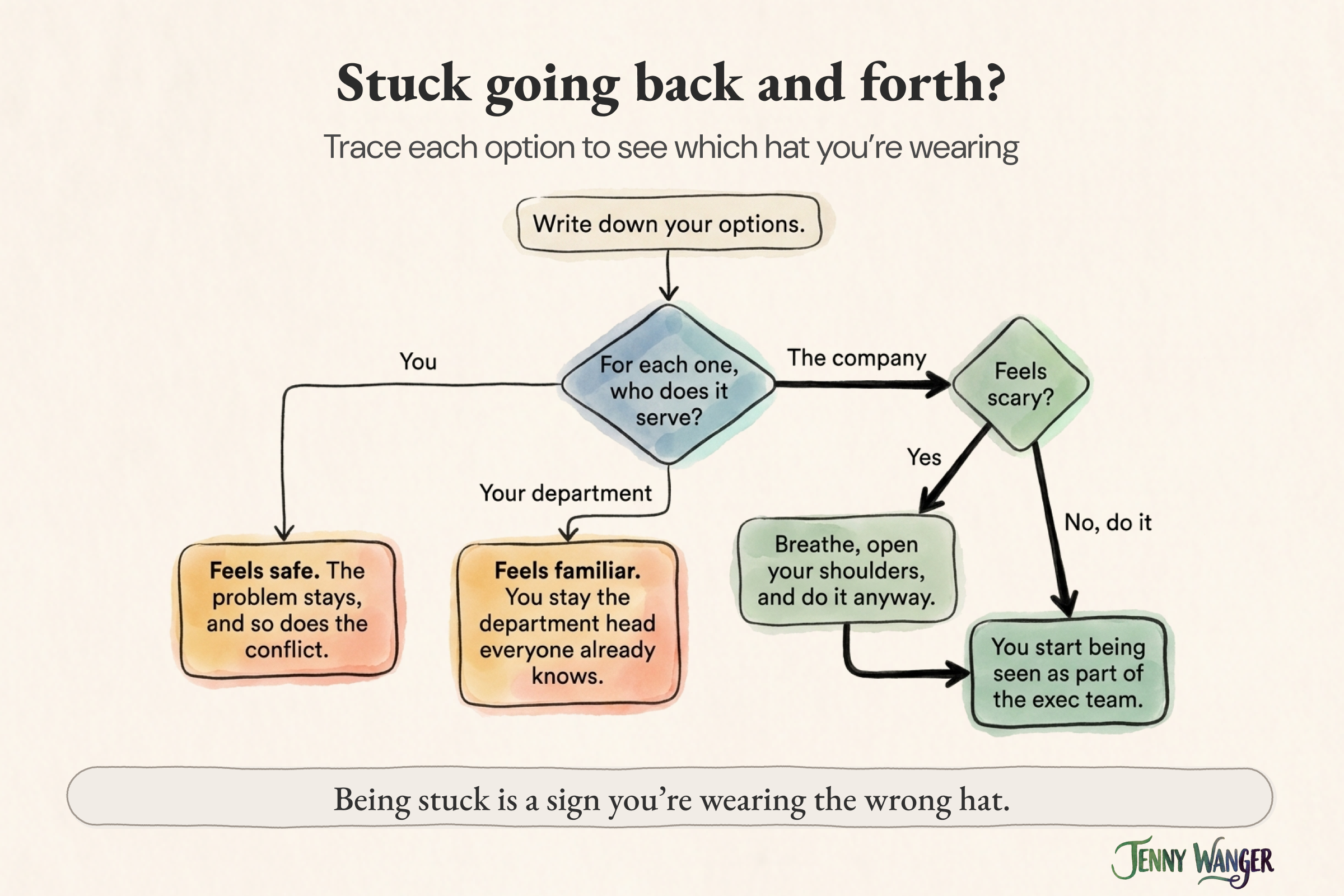
What I work on with my clients instead: if you’re stuck on a decision or going back and forth between options, map them out. Write them down, then answer one question for each:
- Is this the option that’s best for you?
- Is it the one that’s best for your department?
- Or is it the one that’s best for the company?
The most comfortable option is probably the one that’s best for you. It usually avoids conflict and feels easy, which makes it attractive.
The one that’s best for your department is the one that got you promoted to the executive team in the first place. It’s the one where you get to say, “I take really good care of my people, and I’m a great leader.” It’s familiar, and it feels good.
The one that’s best for the company sometimes feels like it contradicts the other two. It’s uncomfortable. It might mean advocating for a smaller budget for yourself and a larger one for someone else, or having a tough conversation with someone who doesn’t report to you. But if your priority is the company and the executive team, that’s the option you have to take.
There’s a physical piece too, and I mean it literally. When my clients look at these scarier options, I have them take a deep breath, release the tension from their shoulders, and feel their chest expand. Then they look at the questions again and decide which move is best given their responsibilities to their first team.
When their body opens up, their thinking tends to open up with it. A bit of physical comfort can help them face the more uncomfortable choice.
And then it wasn’t too scary
In our next session, Corinne told me about her conversation with her peer. She told him she was worried about the manager and the success of the sales project.
He agreed with her assessment and made a deliberate effort to spend more time with that manager.
Not only that, but he started treating Corinne more like an established member of the executive team, asking her to join in on a strategy deep dive. Giving a colleague direct feedback increased her influence in the org.
If you’re struggling with something that feels like a tough decision, take a look in the mirror and ask which hat you’re wearing, and which one you should be wearing. Once you’re clear on the hat, you’re usually clear on the answer too.