
Why your team also needs to see the simple stuff
There are two ways I get into a swimming pool. When I’m there to maximize my 1-hour workout before I take the kids to school, I jump in and start swimming as fast as possible.
When I’m at the pool with my kids, I’m the opposite. I’m one of those people who goes in step by step and then walks on my tiptoes until I’m ready to put my shoulders in and eventually get my hair wet.
In the previous article, I talked about how it’s important to get your hair wet to show what’s important to you, and I mentioned briefly the power of demos.
At one company, I pulled data around AI usage for individuals and managers and mapped that against data I collected in 1:1 interviews at all levels of the company. The data showed clearly that regular demos were one of the most consistent drivers of AI adoption across the 50-person product org.
But not every demo helps.
Fancy demos are scary
I have seen some really cool demos of vibe-coded apps, workflows, and tools.
For instance, one product manager at this company built a social listening tool that keeps an eye on all of the App Store reviews across platforms and synthesizes that feedback. It runs sentiment analysis. It groups things by category. It filters comments by release so that any product manager at the company can understand where the user base is complaining and where they’re happy.
It is awesome. It also took him hours to develop. Many, many hours.
On the one hand, I’m glad he showed off his work. It’s great work and deserves the spotlight.
On the other hand, when the team saw this demo, we felt like we’d use it, but we were never going to build something like it ourselves. It looks hard. Maybe even scary. You have to worry about data structures. UX considerations. You need evals and token monitoring.
Awesome demos show you what’s possible, but they can also intimidate people who are watching. They can make people feel, “Oh, this AI stuff isn’t really for me” or “I don’t have time to build something like this.”
Simple demos aren’t lame
One of my best-received articles this year was about the AI diary skill I built. It’s mostly a write-up explaining how I did it, and the skill is essentially one simple prompt. It creates a file on your computer that logs what you did with AI that day.
One of the reasons is that it was what I think of as a simple demo.
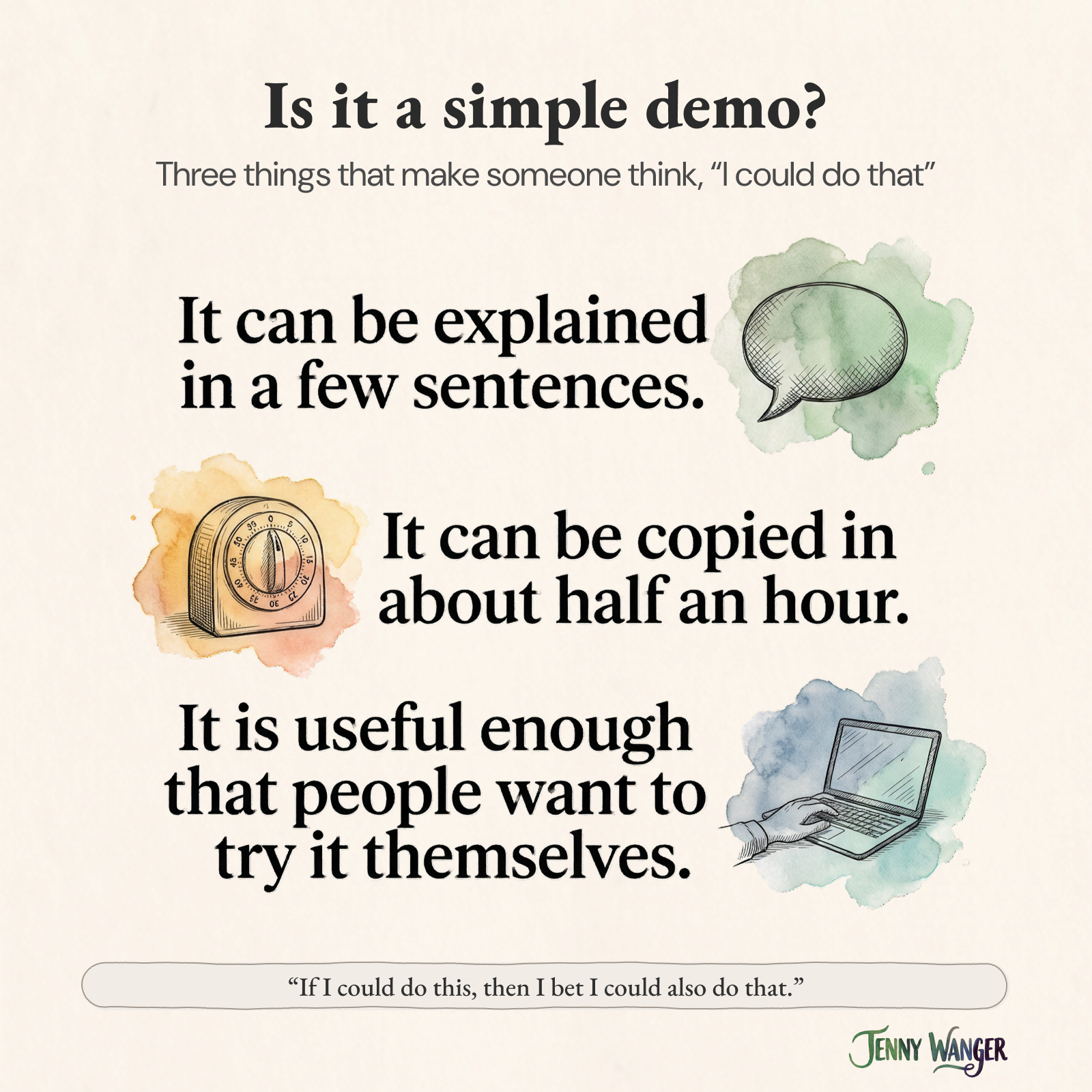
A simple demo meets a few criteria:
- It can be explained in a few sentences.
- It can be copied in about half an hour.
- It is useful enough that people want to try it themselves.
I can explain the AI diary in a sentence. It is just a one-paragraph prompt, so people feel, “Oh, I could do that, and it won’t take me too long.” The applications are clear, and it helps you improve your skills using AI, so people want it.
I demoed the AI diary with this client. A number of people were able to put it into action within minutes of me showing the demo. They saw how useful it was going to be for the next performance review, and how easy it was to get started.
At the companies I’ve been working with, once people try the simple demos, they start to feel like there isn’t a huge buy-in cost to using AI better. Once they’ve found a few first wins, they start thinking about their own ideas and use cases. “If I could do this, then I bet I could also do that.”
Have fun in the whole pool
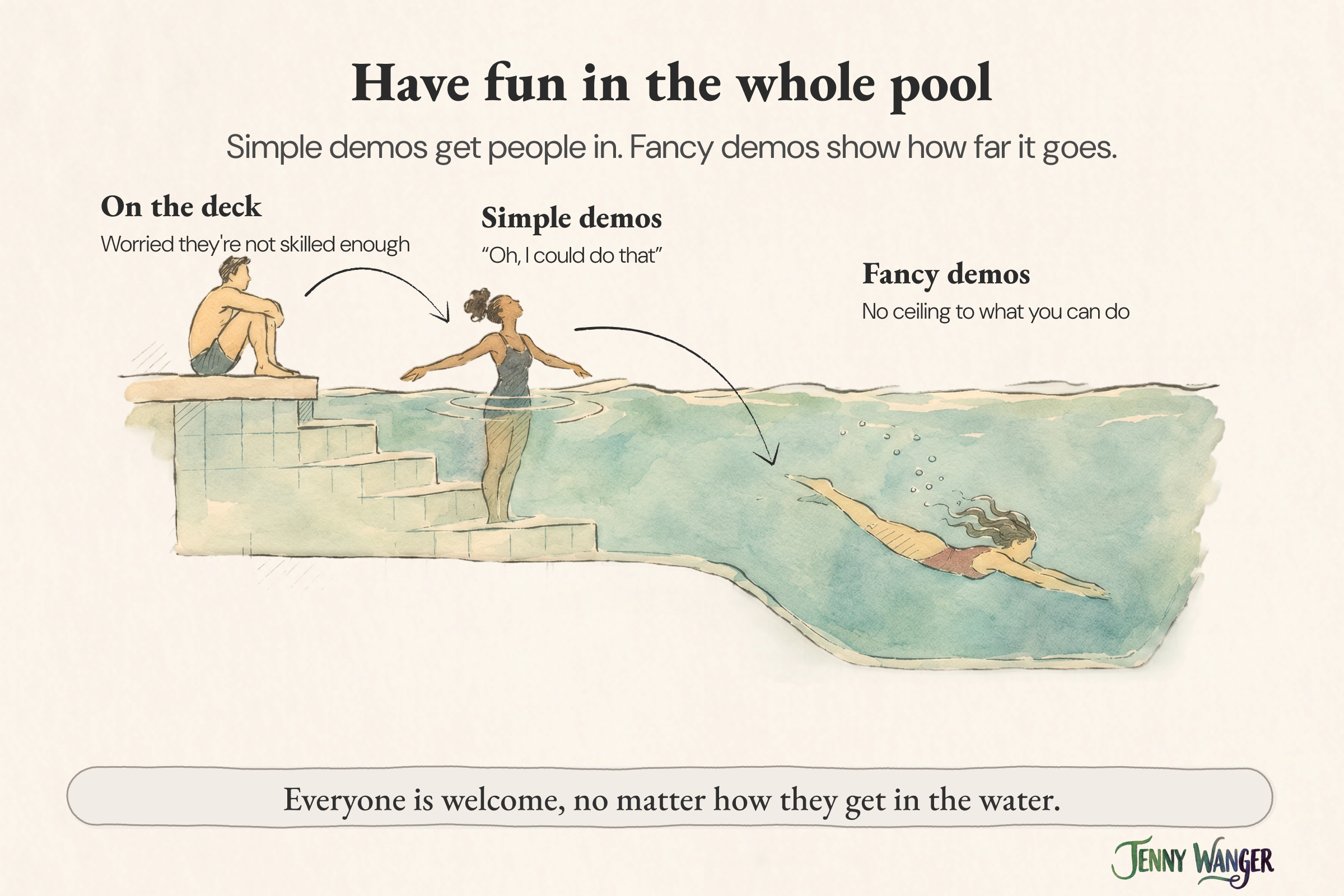
The teams with the greatest success had both the simple demos and the fancy ones: a mix of what you can try now and where things can go in the future. The point was to encourage people to get wet up to their shoulders and to show that the deep end is really fun. Simple demos show that quality AI use doesn’t need to be fancy or complicated. Fancy demos show that there’s no ceiling to what you can do.
Managers kept it lightweight. They reserved 5-10 minutes at the end of their weekly team meeting for demos. They tapped 1-2 people to share no more than 5 minutes of what they did and a few lessons learned. No slides, minimal prep. They answered questions as they popped up. Occasionally the manager would be one of the people to demo.
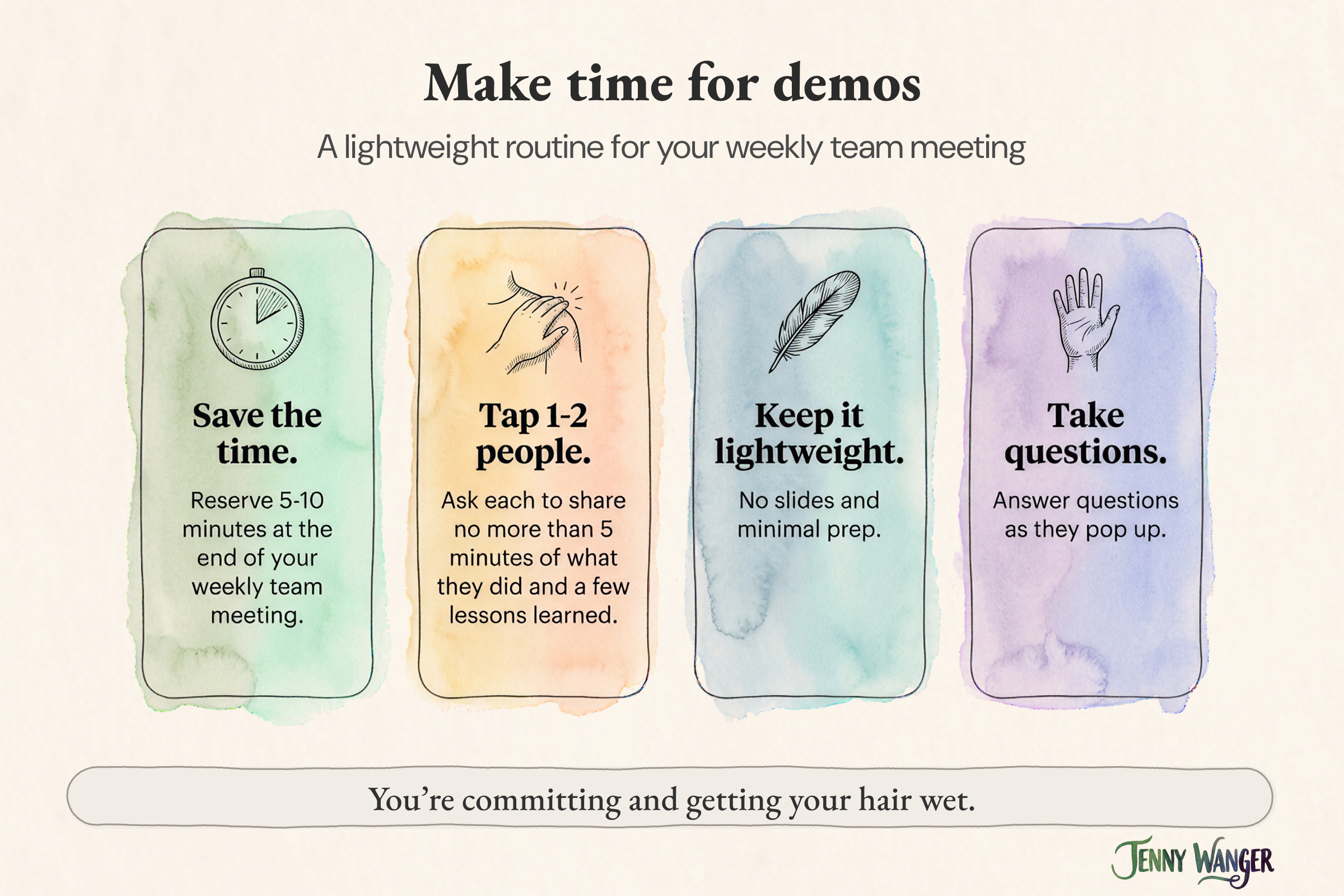
Dedicating time in regular meetings signals that this is an important skill you’re expected to build. You’re committing and getting your hair wet.
Building a learning culture
Simple demos tell your team that you’re building a learning culture. Fancy demos alone can make it seem like only high performance is valued (HT: Cat Hicks’s latest book, go read it). Simple demos communicate that small wins are encouraged. That learning is part of the job.
If you have a company where it looks like everyone is jumping in for a workout, the less confident swimmer won’t want to ease their way in via the shallow end and be there alone. They’re more likely to sit on the deck, dry and worried they’re not skilled enough. The right demos let them know that everyone is welcome, no matter how they get in the water.
Take the last few minutes of your next meeting and find someone who has been in the shallow end. Invite them to share a simple demo to show that everyone can join in the fun.